
talabat Posts Strong Q2 2026 Performance, Lifts Full-Year Outlook Across the Board


- GMV climbed 12% year-on-year, fueled by an expanding customer base — with underlying growth of roughly 15% once the impact of the shifting Eid al-Fitr calendar is stripped out
- Margins held firm, with Adjusted EBITDA at 5.0% of GMV and net income at 3.4% of GMV, consistent with the Company’s planned phase of investment
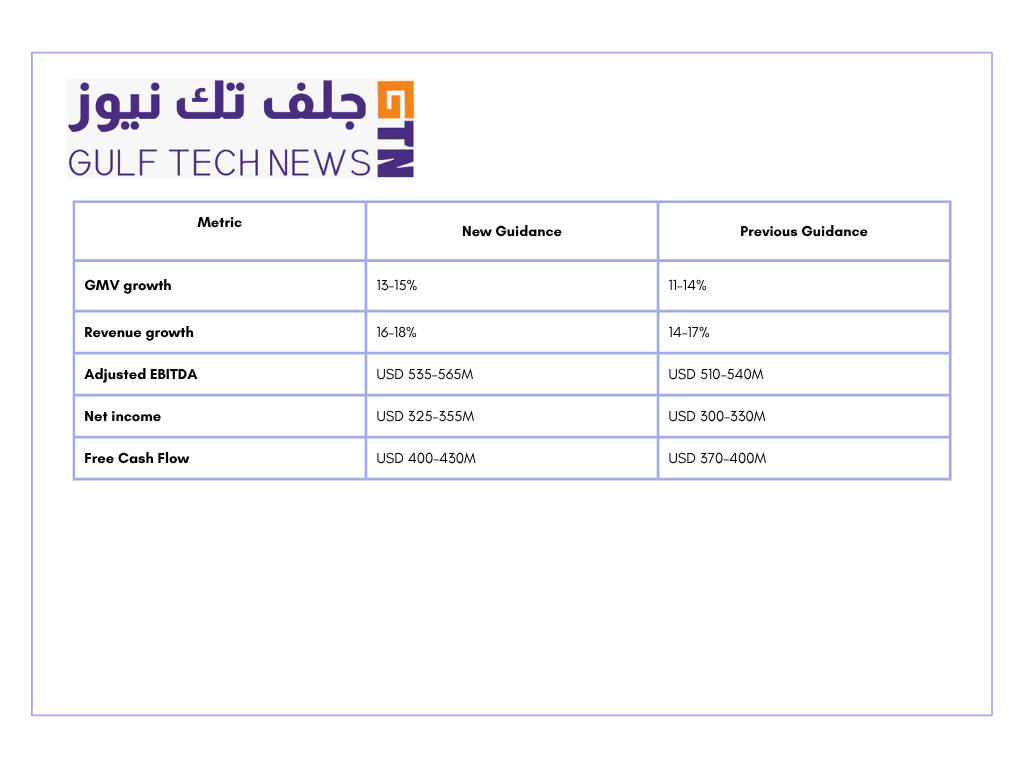
- Full-year guidance upgraded across every key metric: GMV growth now expected at 13–15%, revenue growth at 16–18%, Adjusted EBITDA of USD 535–565 million, net income of USD 325–355 million, and Free Cash Flow of USD 400–430 million
- Share buyback programme underway, with 0.46% of issued capital repurchased so far for approximately USD 35 million at an average price of AED 1.182 per share
Talabat Holding plc (“talabat” or the “Company”), the leading everyday app in the MENA region, today announced its financial results for the second quarter and first half of 2026, covering the period ended 30 June 2026. First-half performance surpassed the Company’s own full-year guidance, supported by steady underlying growth, healthy margins, and strong free cash flow generation — prompting an upward revision to guidance across all five key metrics.
Quarterly results were influenced by the shifting timing of Eid al-Fitr, which occurred ten days earlier in 2026 than in the prior year. This calendar shift boosted top-line growth in Q1’26 while making the Q2’25 comparison base tougher. On a reported basis, Q2’26 GMV rose 11% year-on-year (12% at constant currency); once adjusted for the calendar effect, underlying growth for the quarter was approximately 15% year-on-year — in line with performance across the first half overall.
The Company’s 2026 strategic investment programme — a Board-approved USD 120 million initiative to expand its everyday app — remains on track, with Grocery & Retail adoption already accelerating. At the same time, Food delivery continued to perform resiliently, with talabat retaining its leading position across all markets while spending below its full marketing budget. This combination of disciplined spending and strong execution has translated into improved margins, supporting the decision to raise guidance.
talabat’s financial position remains solid, backed by free cash flow of USD 162 million for the quarter and USD 266 million for the first half. During the quarter, the Company launched its share buyback programme, which shareholders approved at the April 2026 AGM. As of 12 August 2026, talabat had repurchased 108.1 million shares at an average price of AED 1.182 per share, for a total cost of approximately USD 35 million — representing 0.46% of issued capital. The Company’s dividend policy remains unchanged, with 90% of net income to be distributed; interim dividends on H1’26 earnings are expected to be declared in September 2026 and paid the following month.
Second Quarter Highlights
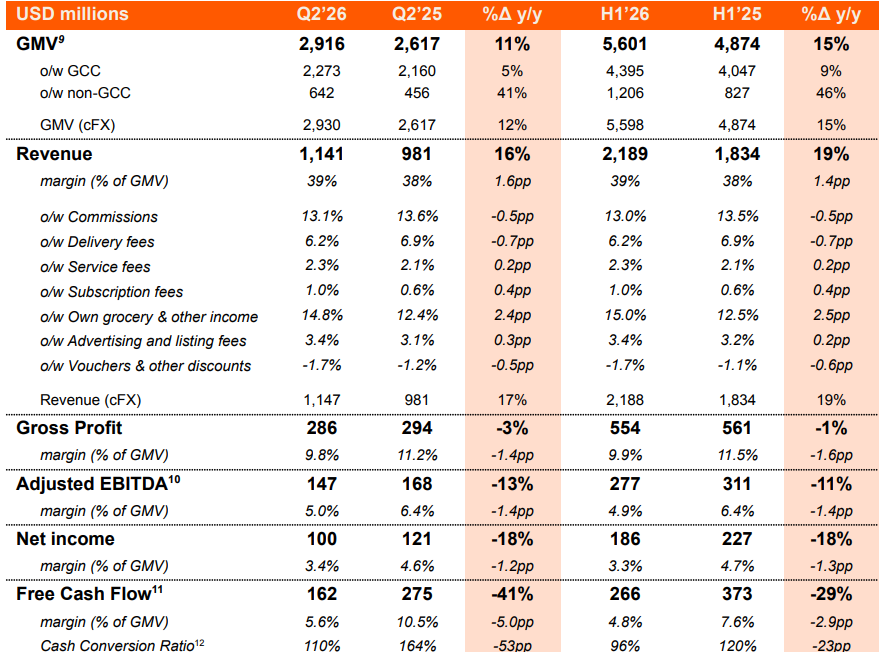
GMV reached USD 2.9 billion, up 11% year-on-year (+12% at constant currency), driven by a growing customer base. Once adjusted for the shifting timing of Eid al-Fitr, underlying growth stood at approximately 15%. For the first half as a whole, GMV totaled USD 5.6 billion, up 15% year-on-year at constant currency — surpassing the Company’s original full-year guidance range of 11–14%.
- GCC markets contributed USD 2.3 billion in GMV, up 5% year-on-year, though their share of the total slipped to 78% (from 83% a year earlier)
- Non-GCC markets delivered USD 642 million in GMV, up a sharp 41% year-on-year, lifting their share of total GMV to 22% (from 17%)
Revenue came in at USD 1.1 billion, up 16% year-on-year (+17% at constant currency), pushing the GMV-to-revenue conversion ratio to 39%, from 38% a year earlier. Revenue growth outpaced GMV growth largely thanks to a rising contribution from own-grocery sales (talabat mart) and expanding advertising-technology margins. This was partly offset by lower commission rates — a byproduct of Grocery & Retail’s growing share of GMV — along with higher incentive spending aimed at customer acquisition and retention.
Adjusted EBITDA totaled USD 147 million, down 13% year-on-year and equivalent to 5.0% of GMV (versus 6.4% previously). The margin compression stemmed from two planned investment areas: reinforcing talabat’s leadership in Food delivery and building out the everyday app ecosystem, both consistent with the Board-approved strategy.
Net income stood at USD 100 million, an 18% decline year-on-year, representing 3.4% of GMV (down from 4.6%). The drop mirrors the effect of the investment programme on EBITDA, while costs outside core operations remained largely steady.
Free Cash Flow was USD 162 million, down 41% year-on-year and equal to 5.6% of GMV, with a Cash Conversion Ratio of 110% (compared with 10.5% and 164% respectively in the prior year). The decline is mainly attributable to an unusually favorable working-capital timing benefit recorded in Q2’25 that pushed that quarter’s cash flow above its normal run-rate — a benefit not expected to repeat.
Business Momentum
Core business fundamentals continued to gain strength in Q2’26. The active partner base grew 14% year-on-year to approximately 97,000, with Grocery & Retail partners now making up nearly one in every four — a sign of talabat’s expanding supply beyond its core Food delivery business. Meanwhile, the active rider network grew 25% to around 189,000, supporting delivery quality as the platform scales.
Customer engagement across multiple categories deepened significantly: three out of every four dollars of GMV (75%, up 4 percentage points year-on-year) now come from customers who order across more than one vertical. talabat pro, the Company’s subscription programme, reached a 51% share of platform GMV — 1.4 times its penetration rate from a year earlier — with over one in four active customers now enrolled.
Partners funded a record USD 404 million in customer savings during H1 2026, up 30% year-on-year, while advertising revenue
margin rose to 3.4% of GMV (up 0.3 percentage points year-on-year), continuing to scale in step with overall platform growth.
Everyday App Investments Progressing on Schedule
Earlier this year, talabat outlined a disciplined USD 120 million investment plan for 2026 to expand its everyday app ecosystem — split between roughly USD 75 million in operating expenditure and USD 45 million in capital expenditure. The funds are directed toward increasing talabat mart’s dark-store density and supply-chain infrastructure, broadening talabat pro’s cross-vertical benefits, and developing new retail and adjacent service offerings.
Execution remained largely on track through H1’26, with approximately USD 58 million deployed across operating, capital, and lease spending in these three focus areas. Separately, planned marketing and pricing investment for the Food vertical came in lower than originally budgeted, as stronger-than-expected demand and a more favorable competitive landscape reduced the need for spending.
Commenting on the results, talabat’s Chief Executive Officer Toon Gyssels said the Company carried its strong start-of-year momentum into the second quarter, delivering 15% GMV growth and 19% revenue growth in the first half alongside a 4.9% Adjusted EBITDA margin — outperforming its own full-year expectations. He noted that talabat strengthened its leadership in the Food vertical while spending below its allocated budget, even as its strategic investment programme to build the everyday app continued advancing and already showing encouraging early results. He added that this performance gives the Company confidence to raise its full-year outlook across every key metric.
Full-year 2026 guidance
talabat Q2 and H1 2026 and Q2 and pro forma H1 2025 financial information